Pages from history
Brodzikowskis whose traces survive in armorials, officers’ yearbooks, archives and newspapers. We collect them like pages from a family album.
Where the name comes from
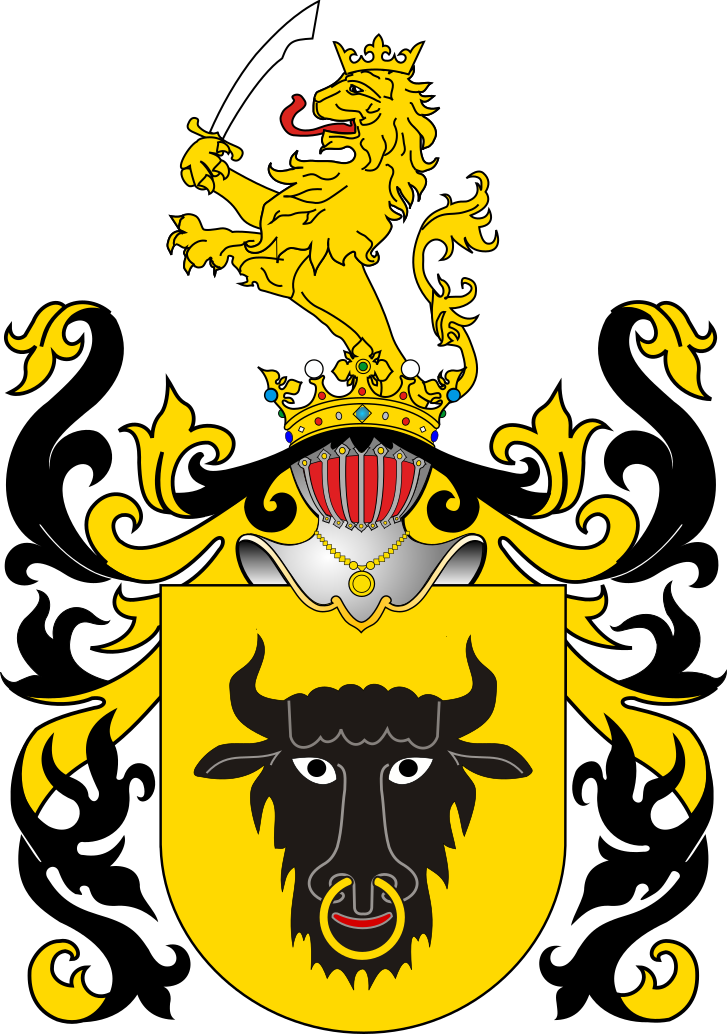
In Tadeusz Gajl’s Herbarz polski (Polish Armorial) the name Brodzikowski is listed among the families of the Wieniawa coat of arms. The name itself most likely shares its root with bród, a ford: a shallow place in a river where one can cross. The surname Brodzik comes from the same word. In Masuria there is a village called Brodzikowo (Mrągowo district), but we know of no evidence that the name comes from it.
The Warsaw line of the Wieniawa arms
The best documented branch of the Brodzikowskis, described in Marek Minakowski’s genealogy (Genealogia potomków Sejmu Wielkiego), lived in Warsaw from the 19th century:
- Wojciech Brodzikowski and Franciszka née Filipkowska: the oldest known generation.
- Leopold Adolf Brodzikowski (c. 1825–1906, died in Marymont, Warsaw) and Ludwika née Turkowska (1836–1918). They had at least seven children.
- Their sons: Aleksander (1853–1936), born in Praga, Warsaw, married to Stefania née Jarzyna, and Konstanty (1874–1954), married to Jadwiga Zofia née Podwińska. Konstanty rests in Powązki Cemetery, in the same grave as his father Leopold.
- Grandsons: Jerzy (1900–1944), an officer, see below; Stefan of the Wieniawa arms (1892–1982), buried in Włocławek; and most likely Kazimierz (1897–1979), an actor.
The full story of the Warsaw line, with photos →
Major Jerzy Brodzikowski
He was born on 17 March 1900 in Warsaw, in the parish of All Saints, the son of Konstanty and Jadwiga née Podwińska. In 1920 he graduated from the Signals Cadet School and went straight to the Polish–Soviet War.
Between the wars he served as a signals officer: in the 1st Signals Regiment in Warsaw, in the telegraph battalion in Grodno and in the Border Protection Corps. From 1938 he commanded the signals of the Masovian Cavalry Brigade, and he was promoted to major in March 1939. In September 1939 he fought with the brigade all the way to the Lublin region. He avoided captivity and returned to Warsaw.
In the underground ZWZ–Home Army (AK) he was head of signals of the Western Area of the Home Army in 1942–1944. In spring 1944 he was arrested by the Gestapo. He died during interrogation at the Gestapo headquarters on aleja Szucha. His burial place is unknown. In Powązki Cemetery he has a symbolic grave with the inscription “ppłk Jerzy Brodzikowski zamordowany w 1944 r. w gestapo” (Lt. Col. Jerzy Brodzikowski, murdered by the Gestapo in 1944).
Sources: Minakowski genealogy (sw.66495); Wikipedia: Signals squadron of the Masovian Cavalry Brigade; R. Rybka, K. Stepan, Rocznik oficerski 1939, Kraków 2006; K. Malinowski, Żołnierze łączności walczącej Warszawy, Warsaw 1983.
Kazimierz Brodzikowski
He was born on 8 January 1897 in Włocławek. In Minakowski’s genealogy, Stefan’s brother (1897–1979) is described as “a man of the theatre” and as an entry in the 1938 lexicon Czy wiesz kto to jest (Who’s Who). Everything suggests that this is him, a grandson of Leopold Adolf.
He studied acting in Warsaw and from 1922 performed on the stages of Warsaw, Kraków, Poznań, Bydgoszcz and Toruń. In 1935 he took over the Municipal Chamber Theatre in Częstochowa. After the war he acted in Bielsko-Biała, Szczecin and Łódź, and from 1957 at the Teatr Młodej Warszawy in Warsaw. At the Łódź Film School he directed graduation productions. He also translated plays from Russian, including Turgenev and Gogol.
He made his film debut in 1932 in Pałac na kółkach. His roles include The Youth of Chopin (1951), Podhale w ogniu (1955), Zemsta (1956) and Andrzej Wajda’s The Maids of Wilko (1979). He died on 12 July 1979 in Warsaw and rests in Powązki Cemetery.
Sources: Kuyavian-Pomeranian Film Trail; Minakowski genealogy (sw.65711).
Lt. Col. Zbigniew Brodzikowski
He was born on 24 May 1907 in Dąbrowica in Volhynia, the son of Jan and Apolonia. This is a different branch from the Warsaw one. After his school-leaving exams in 1928 he graduated from the Infantry Cadet School in Ostrów Mazowiecka-Komorowo. He served in the 44th Infantry Regiment in Równe and as an instructor in Różan, and after a course in Modlin he moved to the armoured forces. In September 1939 he was deputy commander of the 11th Armoured Squadron of the Masovian Cavalry Brigade, the same brigade whose signals were commanded by Jerzy Brodzikowski.
From 1940 he was active in the ZWZ–Home Army underground in the Vilnius region: on the staff of the Wilno District, for a time as commander of Inspectorate “F” (Oszmiana), and in 1944 as head of Section I in the field staff of Lt. Col. “Wilk”. On 17 June 1944 he was arrested. He went through prison in Vilnius and the Soviet camps of Ostashkov and Morshansk. He returned to Poland in November 1947. After the war he was kept under surveillance by the security service, while he wrote down the history of the Home Army in the Vilnius region. He was awarded the Virtuti Militari, 5th class, and the Cross of Valour. He died in 1978.
Sources: J. Wołkonowski, Okręg Wileński ZWZ-AK w latach 1939–1945, Warsaw 1996; L. Tomaszewski, Wileńszczyzna lat wojny i okupacji 1939–1945, Warsaw 1999; P. Niwiński, Okręg Wileński AK w latach 1944–1948, Warsaw 1999; Wilno District Command of the ZWZ-AK. The name is sometimes garbled in the literature, e.g. as “Zdzisław”.
Cpl. Paweł Brodzikowski
He was born on 6 March 1983 and came from Jackowo in the Nasielsk district, where he was also a member of the volunteer fire brigade. He began his military service in 2002 in Orzysz, and in 2008 became a professional soldier of the 2nd Masovian Sapper Brigade in Kazuń, as a driver and medic.
In May 2008 he left on a mission to Afghanistan. On 20 August 2008, during a patrol near Shawal in Ghazni province, a charge exploded under his vehicle. He was killed together with two comrades. He was posthumously promoted to corporal and awarded the Knight’s Cross of the Order of the Military Cross. He rests in the cemetery in Nasielsk.
Sources: Polish Armed Forces: remembering the fallen in Afghanistan; TracesOfWar: grave in Nasielsk; Fallen Heroes Project.
Searching further
We now know that grandfather Stanisław Brodzikowski (1894–1969) was the son of Bolesław and Julia née Iwanicka, and through them a great-grandson of Wojciech of the Warsaw line. His marriage record of 1919 confirms it. We are still searching: for Antoni’s ancestors, for what became of grandfather’s brothers Edmund and Bolesław Edmund, and for whether the Brodzikowskis from Volhynia and from around Nasielsk are related to us. Useful databases: Geneteka (indexes of parish registers), metryki.genealodzy.pl (scans of registers), Minakowski genealogy, straty.pl (victims of the Second World War) and an overview of name lists.
We wrote the biographies on the basis of the sources given; we first collected them in 2011 on the family website brodzikowski.info. We only show people who died more than 10 years ago.