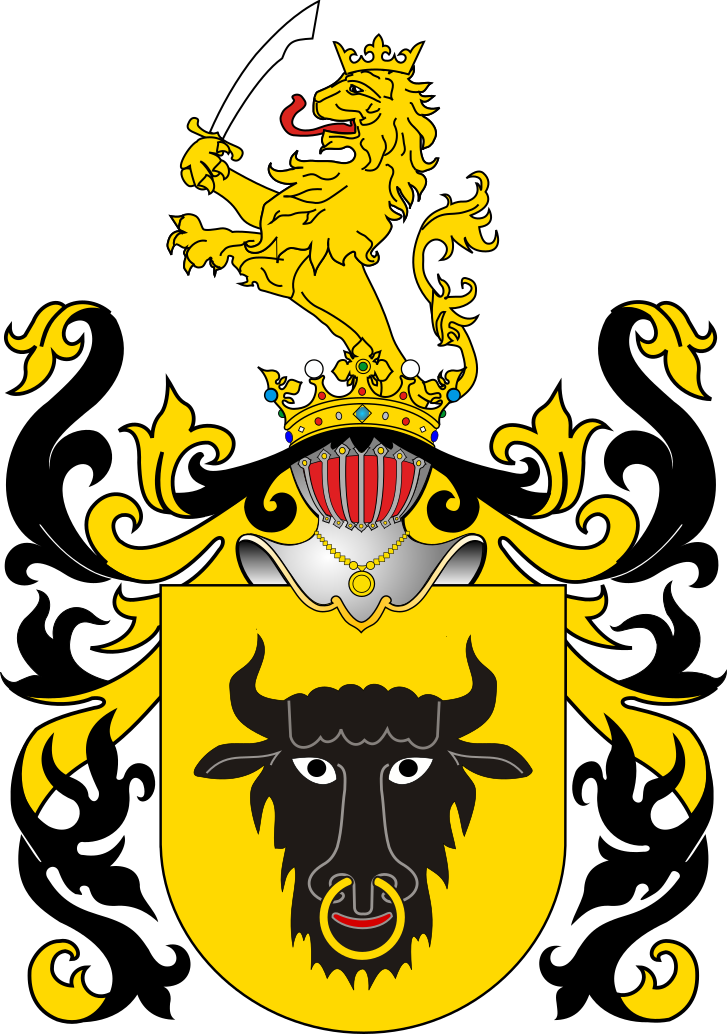
Wieniawa coat of arms
One of the oldest Polish knightly coats of arms. Several hundred families bore it, among them the family of King Stanisław Leszczyński and the chronicler Jan Długosz.
What it looks like
On a gold field there is a black bison’s head with a gold ring through its nostrils. Above the shield, as the crest, is half a crowned gold lion holding a sabre in its right paw. The mantling, the decorative cloth around the shield, is black lined with gold.
The legend
Old heralds, citing Jan Długosz, told the story of the coat of arms like this:
A prince of Moravia rode out hunting for his pleasure, and a bison barred his way. Seeing this, a knight named Łastek, who attended the prince and was a man of great strength, seized the beast by the horns and not only held it fast, but cut a withy from a young oak, forced it through the bison’s nostrils, twisted it into a ring, and so led the animal to his prince. When he gave it to another courtier to hold, the bison, sensing that this man had no such strength as could master it, began to tear itself free and struggle. Łastek, seeing this, drew his sword and struck its neck so hard that with a single blow he cut off the bison’s head. Praised by the prince for this courage, the noble man received a great estate as a reward, and this coat of arms, bearing that very bison’s head.
That is why the arms show a black bison’s head with a ring through its nostrils, a reminder of the oak withy. The same motif appears in the 18th-century armorial of Kasper Niesiecki.
In 1593 Bartosz Paprocki recorded a Moravian version. According to it, the arms were given by the King of Bohemia to a charcoal burner named Věňava, together with nobility and land near the later castle of Pernštejn.
Earliest records
- 1382: the oldest known seal with these arms, belonging to Piotr Drzeczkowski of Morkowiec.
- 1388–1389: further seals of the Drzeczkowski family and court records.
- 1410: a banner bearing this sign fought at Grunwald, led by Jan of Obiechów.
- 15th century: the arms also reach Lithuania.
War cry
The war cry of the clan was simply the word Wieniawa. Its origin is uncertain. Older writers linked it with the withy from the legend, with the knight’s name or with a Moravian battle cry. The linguist Aleksander Brückner derived it from wiana, a small broom of leaves.
Famous bearers
- Jan Długosz, chronicler and historian
- Stanisław Leszczyński, King of Poland
- Maria Leszczyńska, Queen of France
- Andrzej Leszczyński, Primate of Poland
- Bolesław Wieniawa-Długoszowski, general and aide-de-camp to Piłsudski
The Brodzikowskis of the Wieniawa arms
The name Brodzikowski appears on the list of families of the Wieniawa coat of arms in Tadeusz Gajl’s Herbarz polski (Polish Armorial), alongside the Brodnicki, Brodowski and Bronisz families, among others. Armorials list the names of families that used a given coat of arms. They do not prove, however, that every family of that name descends from the same ancestors. We have not yet confirmed our noble roots in documents.
Sources: the article Wieniawa (herb szlachecki) in the Polish Wikipedia (CC BY-SA 4.0); Tadeusz Gajl, Herbarz polski od średniowiecza do XX wieku.